Out of the Box Models
AAR Postwar Aluminum Boxcar
AAR Postwar Aluminum Boxcar
Couldn't load pickup availability
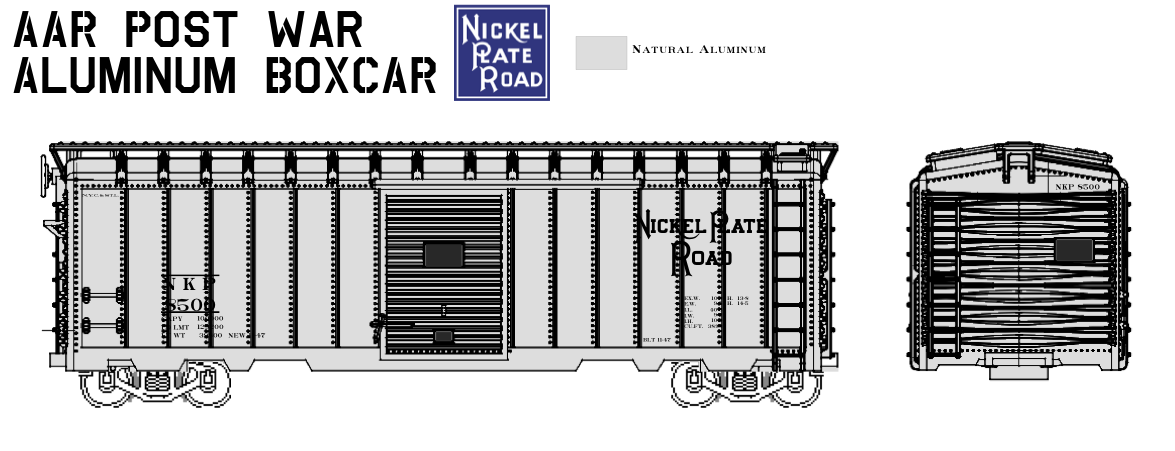
These are N scale 3D printable files for the AAR Postwar Aluminum Boxcar — one of the rarest and most unusual freight car variants of the postwar era, built by the Mt. Vernon Car Manufacturing Company in 1947 in aluminum rather than the standard steel construction of the period. Only 20 of these cars were ever built — 10 for the Chesapeake & Ohio Railway (C&O, road numbers 2900–2909) and 10 for the Nickel Plate Road (NKP, road numbers 8500–8509) — making them among the most distinctive and seldom-modeled boxcars in American freight car history. Available in two road name variants: C&O and NKP.
The AAR Postwar boxcar was the standard American freight car design of the late 1940s and 1950s, developed by the Association of American Railroads to bring uniformity and interchangeability to the nation's freight car fleet after World War II. What makes these 20 cars exceptional is their aluminum construction — an experiment in weight reduction at a time when railroads were exploring lightweight materials to improve payload efficiency and reduce wear on track and equipment. While steel AAR boxcars of the era typically featured 10 or 12-panel sides in either riveted or welded construction depending on the builder and prototype, the aluminum carbody of these Mt. Vernon cars used 14-panel riveted sides — a distinctive feature of the aluminum construction itself. They shared the same period-correct hardware as their steel counterparts: Youngstown doors and 3/4 Improved Dreadnaught ends, making these 40-foot cars visually familiar in a mixed freight consist while their unusual carbody material set them apart from everything else on the railroad.
Like most aluminum boxcars of the era, the C&O and NKP cars were initially assigned to express service on passenger trains — a natural fit for lightweight equipment, where their reduced tare weight translated directly into faster acceleration and less strain on passenger locomotive consists. This gives the modeler a prototypically accurate reason to place these cars in passenger train consists as express boxcars before they eventually migrated to general freight service later in their careers.
The two road names reflect the experimental nature of the order — split between two Midwest railroads with close operational ties, allowing a direct comparison of aluminum versus steel performance in revenue service. The C&O and NKP were both Van Sweringen roads with intertwined histories, making the pairing of these experimental cars across the two fleets a natural choice for railroad management evaluating the technology.
For the modeler, these cars offer a rare opportunity to add a genuinely unusual and historically significant prototype to a layout — cars that work equally well trailing a passenger varnish in express service or tucked into a mixed freight consist, each placement telling a different chapter of their operational story.
After purchase, your digital files will be available for immediate direct download from your order confirmation. These files are for Personal Use Only — if you are interested in a commercial license, please contact us.
Please allow a few weeks for 3D printing and shipping. Decals are shipped separately — please allow some additional time for decal printing and shipping after ordering.