ootbModels
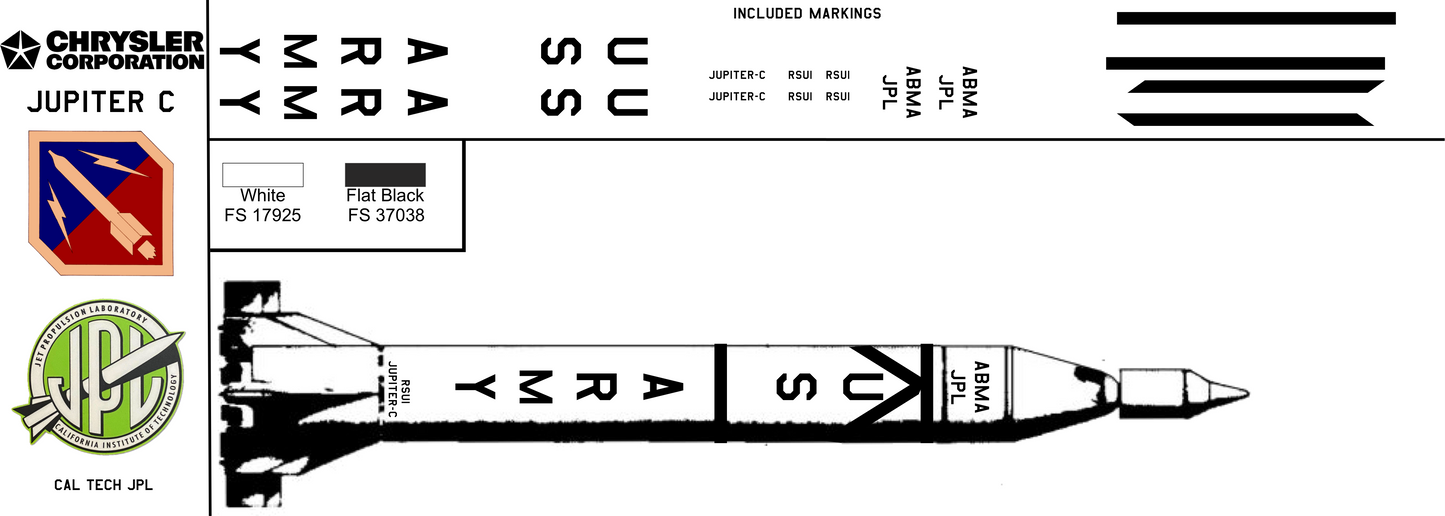
Jupiter C Orbital launch vehicle September 20th 1956 Launch
Jupiter C Orbital launch vehicle September 20th 1956 Launch
Couldn't load pickup availability
These are 1/72 scale decals for the Jupiter C launch vehicle as it appeared on 20 September 1956, during one of the most remarkable — and bittersweet — flights in the history of American rocketry, conducted by the Army Ballistic Missile Agency (ABMA) at Cape Canaveral, Florida.
The Jupiter C was a three-stage research vehicle derived from the Redstone ballistic missile, fitted with two upper stages of clustered solid-fuel Sergeant rockets to achieve the extreme velocities needed to test re-entry vehicle nose cones at realistic ballistic speeds. The 20 September 1956 launch was a spectacular success — the vehicle reached an altitude of approximately 1,097 kilometers and a range of over 5,300 kilometers, setting records for both altitude and distance by an American rocket at the time.
What makes this particular flight so historically poignant is what didn't happen: the Jupiter C's fourth stage, which could have carried a small satellite into orbit, was deliberately filled with sand ballast rather than a live rocket motor. Dr. Wernher von Braun and his ABMA team knew they had the capability to orbit a satellite on this very flight, but the Eisenhower administration had decided that America's first satellite would be launched by the Navy's civilian Vanguard rocket rather than an Army missile. Had the fourth stage been live on 20 September 1956, the United States would have beaten Sputnik 1 into orbit by more than a year. Instead, von Braun's team waited — and it was not until after Sputnik shocked the world, and Vanguard failed on the launch pad, that ABMA was finally given the green light to try, succeeding with Explorer 1 on 31 January 1958.
One of the great "what ifs" of the Space Age, captured in 1/72 scale. Please allow some time for decal printing and shipping.